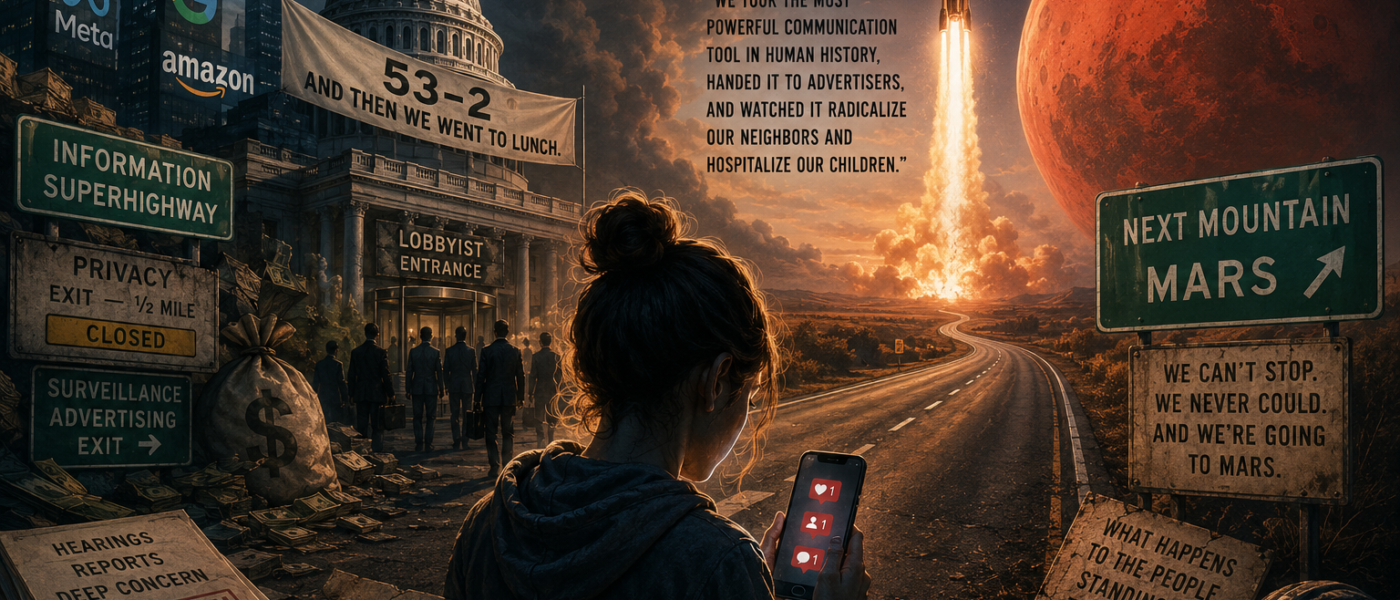
There is a particular kind of American optimism that doesn’t ask questions. It sees the mountain, plants the flag, and sends the bill to the next generation. It built the railroads — and the company towns that made serfs of the men who laid the tracks. It struck oil — and didn’t mention the water table. It split the atom — and figured out the fallout policy somewhere around Hiroshima. We are constitutionally incapable of slowing down long enough to ask the one question that history keeps submitting for our consideration: what happens to the people standing on the tracks?
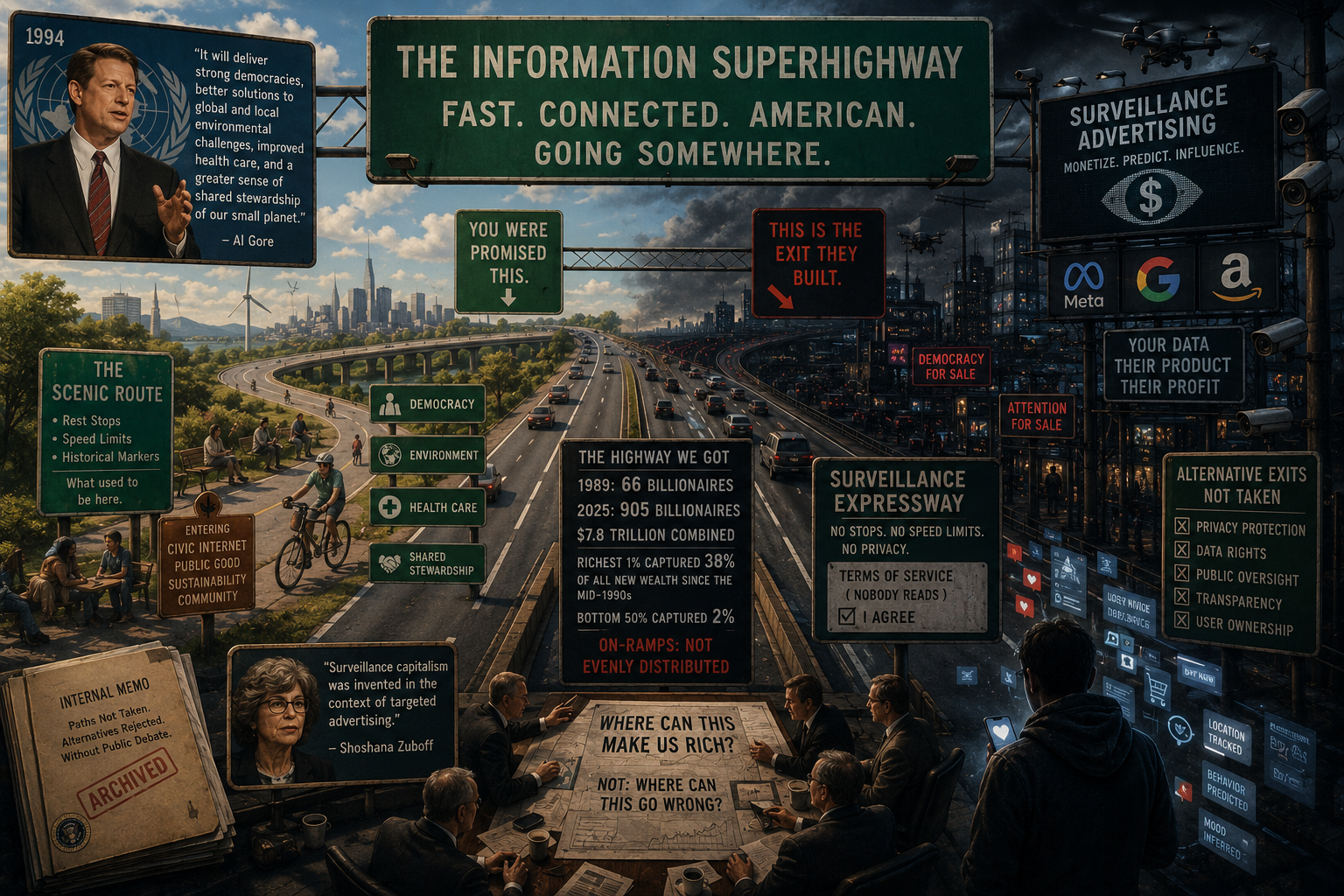
In 1978, a young senator from Tennessee gave a technology living in university basements and defense department memos a metaphor that a nation of interstate drivers could understand. Al Gore didn’t invent the Internet — that myth has been corrected enough times that only cable news still believes it — but he did something arguably more consequential. He sold it. The Information Superhighway. Fast. Connected. American. Going somewhere. Speaking to the International Telecommunications Union in 1994, he promised it would deliver “strong democracies, better solutions to global and local environmental challenges, improved health care, and a greater sense of shared stewardship of our small planet.” He wasn’t lying. He was just describing the scenic route — the one with rest stops and speed limits and the occasional historical marker explaining what used to be here before we built the road.
That is not the highway we got.
The highway we got made a small number of people wealthy beyond the accounting capacity of previous centuries. In 1989, there were 66 American billionaires. By 2025, there were 905, holding a combined $7.8 trillion. The richest 1% have seen their household wealth more than quadruple since 1989. The richest 1% captured 38% of all new wealth accumulated since the mid-1990s. The bottom 50% captured 2%. The superhighway was built. The on-ramps were not evenly distributed.
The planners knew where it was going. Archival research at the Clinton Presidential Library reveals a history of paths not followed and alternatives rejected without public debate — a consistent pattern in which the privacy-protective exit was passed and the surveillance advertising exit was taken. Every time. Surveillance capitalism, as Harvard professor Shoshana Zuboff rather politely observes, “was invented in the context of targeted advertising.” Not stumbled into. Invented. By people who understood exactly what they were building and correctly identified that the rest of us would never read the terms of service. The question that got the venture capital wasn’t where can this go wrong? It was where can this make us rich? We didn’t fail to plan. We planned for the wrong thing. Deliberately.
The internet is extraordinary. It connected the world, democratized information, toppled dictatorships, and allowed your uncle in Tulsa to share his opinions about the moon landing with a global audience at three in the morning. Some of that is genuinely wonderful. Some of it we’ll get to.
What we did not build was a plan for what happens when that system is aimed at a seventeen-year-old girl who is already uncertain about who she is. Teenagers who spend more than three hours a day on social media face double the risk of mental health problems. The average American teenager spends three and a half hours a day on social media. A 2025 study found that 40% of depressed and suicidal youth reported problematic social media use. A 2026 survey found that 84% of Americans are concerned about technology’s effect on misinformation and 74% on political polarization. Only 26% say social media has had a positive effect on society. We had the data. We wrote the reports. We expressed, in the carefully modulated language of the congressional hearing, our deep concern. And then we went to lunch.
Here is where we consider the possibility that Congress simply didn’t know. It’s a generous interpretation. It is also, unfortunately, not available to us.
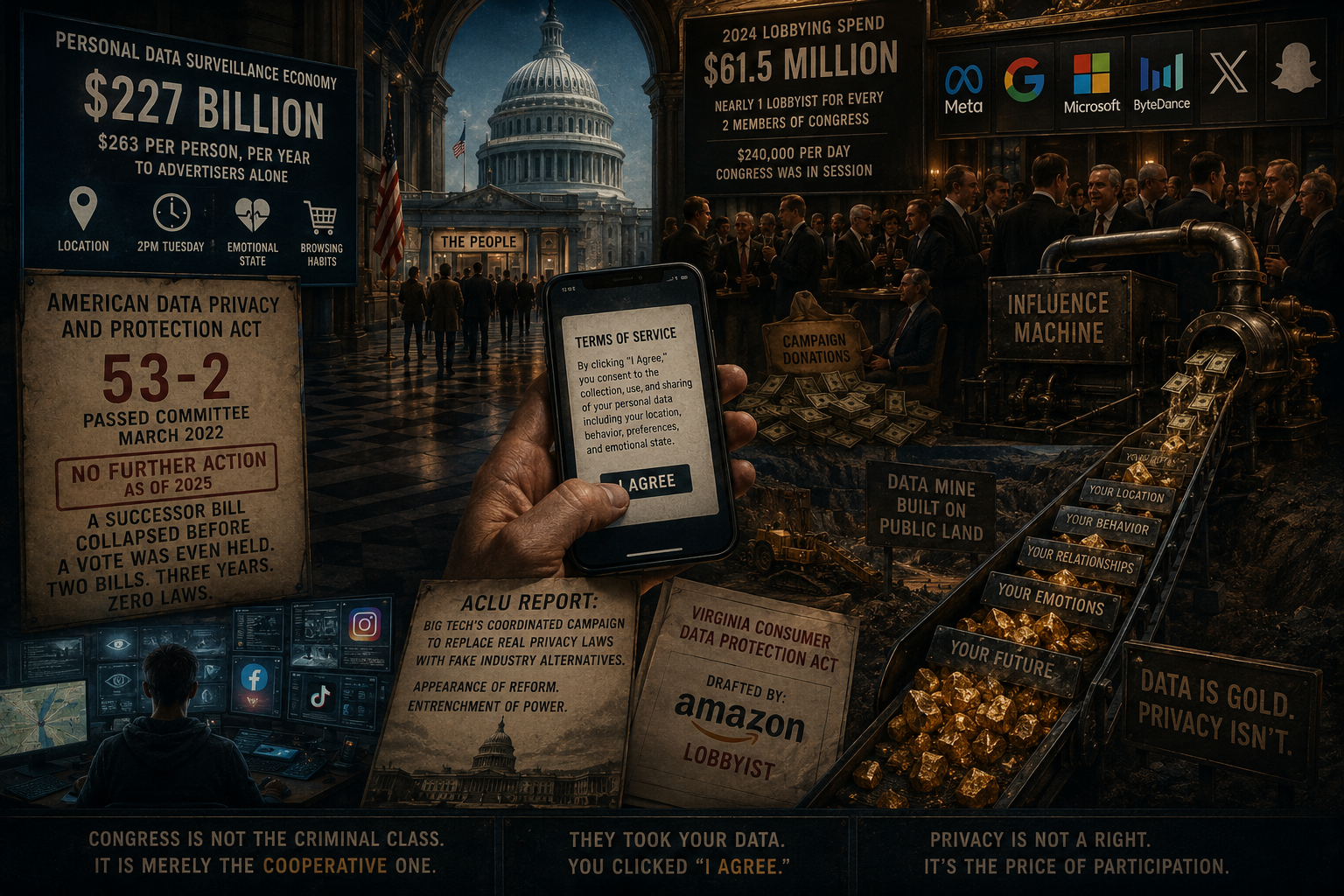
The personal data surveillance economy is worth $227 billion. Your browsing habits, your location at 2pm on a Tuesday, the precise emotional state your scrolling reveals to an algorithm that has studied you longer than anyone who has ever claimed to love you — worth an estimated $263 per person per year to advertisers alone. Congress has known this for years. The American Data Privacy and Protection Act passed the House Energy and Commerce Committee in 2022 with a 53-2 vote. Fifty-three to two. The legislative equivalent of unanimous. As of 2025, it has not moved. A successor bill collapsed before the vote was even held. Two bills. Three years. Zero laws.
The explanation is not complicated. In 2024, Meta, Alphabet, Microsoft, ByteDance, X, and Snap combined to spend $61.5 million on lobbying — nearly one lobbyist for every two members of Congress, at $240,000 per day Congress was in session. The ACLU has documented a coordinated campaign by Big Tech to replace real privacy laws with fake industry alternatives — bills offering the appearance of reform while entrenching corporate interests. In Virginia, a consumer data protection act was effectively written by an Amazon lobbyist.
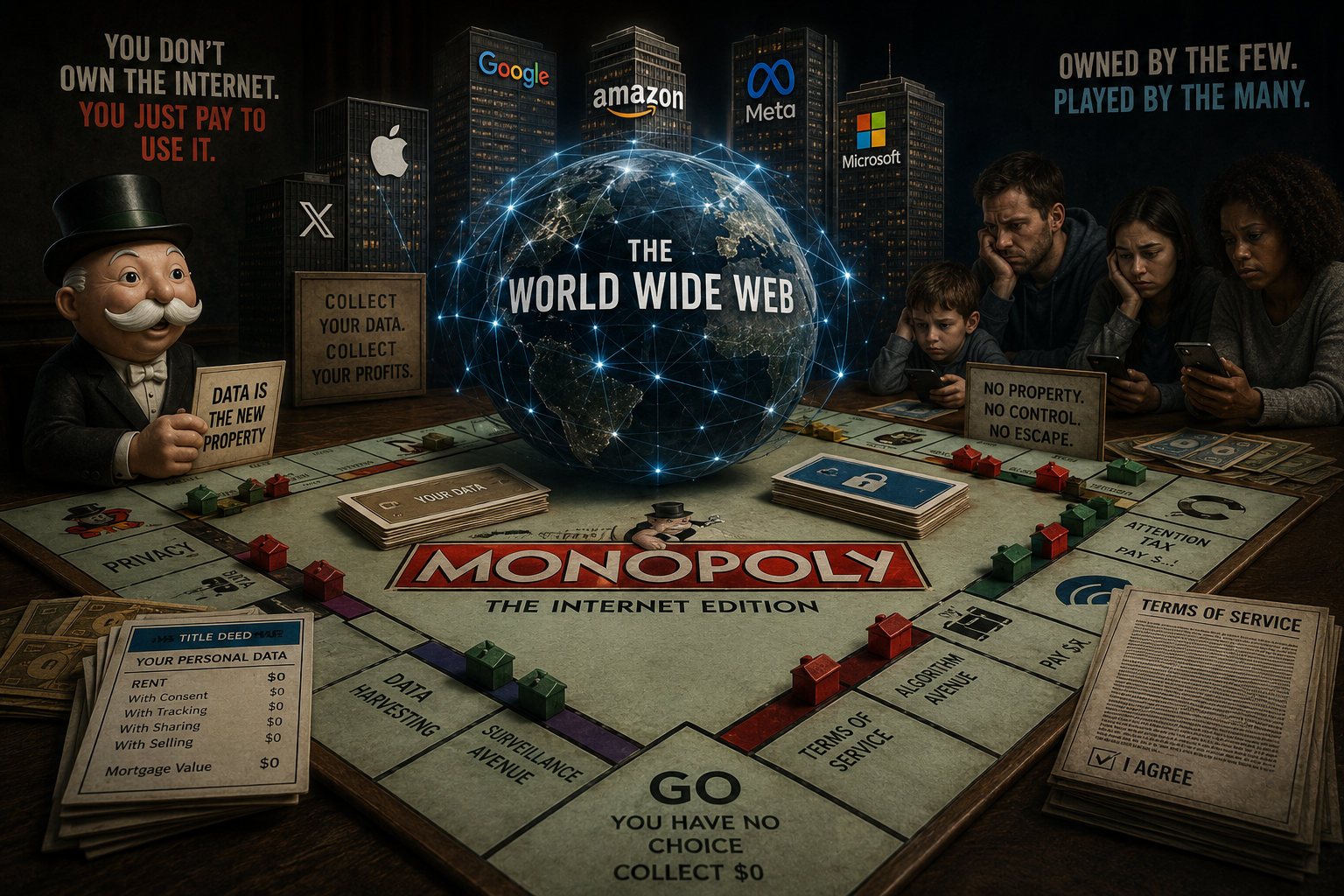
Congress is not the criminal class here. It is merely the cooperative one. The crime was committed by people who understood that data was gold, built the mine on public land, and hired the right people to make sure nobody passed a law about the water table. Privacy in America is not a right, nor even a premium feature. It is simply the thing you surrendered the moment you wanted to be a functioning member of the twenty-first century — and the remarkable part is not that they took it, but that they got you to click “I Agree” on the way out the door.
At this point, someone will clear their throat and offer the standard reassurance: technology always creates more jobs than it destroys. The buggy whip makers became car part makers. Every previous disruption was domain-specific. The loom still needed an operator. The car still needed a mechanic. The implicit promise was: the new thing still needs people.
AI does not make that promise. It doesn’t replace the buggy whip maker and leave the car part maker alone. It replaces the buggy whip maker and then immediately turns around and replaces the car part maker. And the accountant. And the paralegal. And the radiologist. And the entry-level software engineer who was supposed to be the safe harbor. The buggy whip analogy isn’t just imprecise. It’s the sound of someone explaining a house fire with a story about a candle.
Congress has yet to pass a single piece of federal AI legislation. The EU passed its AI Act in 2024, categorizing risk levels and banning the most dangerous applications. On his first day back in office, President Trump revoked Biden’s AI safety executive order — the one requiring companies to share safety test results before deploying high-risk systems — and replaced it with one titled, with the confidence of a man who has never once asked where can this go wrong, “Removing Barriers to American Leadership in Artificial Intelligence.” When states attempted to fill the void, an executive order arrived threatening those efforts too. The EU has a law. We have a newsletter. And an executive order telling the states to sit down.

Let us dispense with the word failure. Failure implies surprise. What we have is a system, functioning precisely as its funders designed it. Innovation arrives. Wealth is extracted. Damage accumulates. Hearings are scheduled. Lobbyists arrive. Legislation dies in committee. Repeat, at increasing speed. This is not incompetence — incompetence can be fixed. What cannot be fixed is a system in which the people writing the laws own stock in the companies the laws would regulate, and the distance between a Senate Commerce Committee hearing and a Silicon Valley boardroom is measured not in miles but in revolving doors.
Twain wrote that “the political and commercial morals of the United States are not merely food for laughter, they are an entire banquet.” He dictated that in 1907. The menu has not changed. The check, as always, goes to the table in the back — the one that didn’t order anything, was never asked what they wanted, and will be paying it off for the next thirty years.
The internet did not happen to us. It was built for us, in the way that a trap is built for something — by the same institutional apparatus always extraordinarily competent at two things: creating wealth for the few, and creating weapons for the many. ARPANET, the internet’s direct ancestor, was a Defense Department project, designed to survive a nuclear exchange. We took the infrastructure of war, handed it to venture capitalists, and expressed surprise at the casualties. AI is the same trap, redesigned with better engineering, wider jaws, and the explicit assurance of everyone involved that this time it’s different. It is not different. The only thing that has changed is the speed.
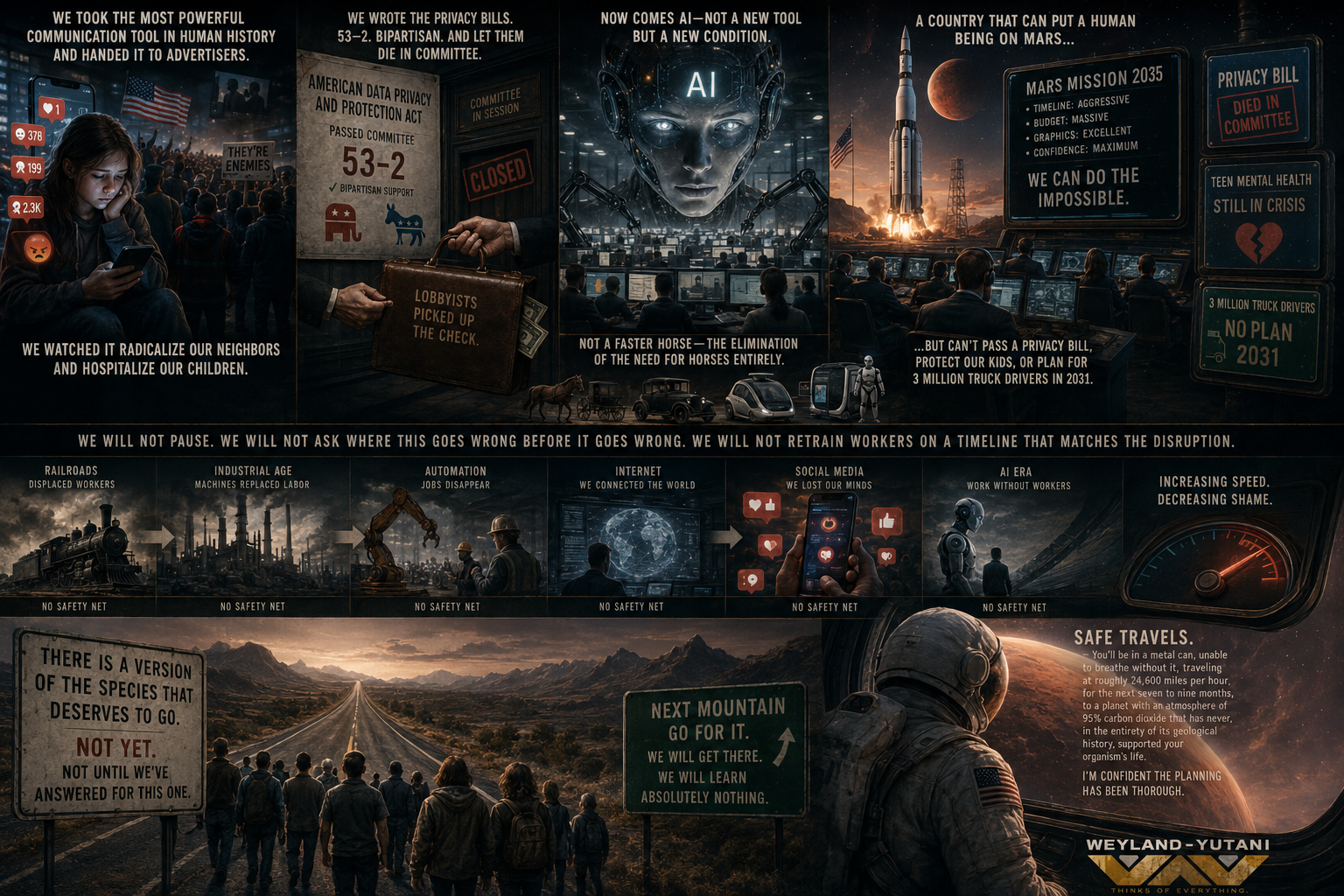
We took the most powerful communication tool in human history, handed it to advertisers, and watched it radicalize our neighbors and hospitalize our children. We wrote the privacy bills, achieved the rare miracle of bipartisan agreement, and quietly let them die in committee while the lobbyists picked up the check. Now comes AI — not a new tool but a new condition, not a faster horse but the elimination of the need for horses entirely — arriving into a country that still hasn’t cleaned up the last mess, governed by a legislature that couldn’t pass a privacy bill with a 53-2 vote and a tailwind.
We will not pause. We will not ask where this goes wrong before it goes wrong. We will not retrain the workers on a timeline that matches the disruption. We know this because we have done it before. Repeatedly. With increasing speed and decreasing shame.
And yet — and here is the part that would have delighted Twain, who understood that American audacity and American neglect are not contradictions but two expressions of the same magnificent, maddening character — we want to go to Mars. Not metaphorically. Actually. With rockets and timelines and the full organizational genius of a civilization that cannot pass a privacy bill or protect a teenager’s mental health or tell three million truck drivers what they’re supposed to do in 2031 — but can, with great confidence and excellent graphics, put a human being on another planet.
There is a version of the species that deserves to go. But that version pauses first. It looks back at the highway it built and the people it ran over and says: not yet. Not until we’ve answered for this one. We are not that version. We are the version that sees the next mountain and starts climbing, because that is what we do, and we will get there, and it will be extraordinary, and we will have learned absolutely nothing from the last four times we did this on Earth.
Safe travels. You’ll be in a metal can, unable to breathe without it, traveling at roughly 24,600 miles per hour for the next seven months, to a planet with an atmosphere of 95% carbon dioxide — a planet that, as best we can tell, has not supported complex life in approximately four billion years, though we did just find a rock that raises some interesting questions.
I’m confident the planning has been thorough.
Weyland-Yutani thinks of everything.
* A note to the reader, I like to be transparent and honest, Yes, I did use AI to help me write this post and to do the images. Claude helped me write the post ( Claude got me verifiable facts ), ChatGpt created the images.